
Wednesday, March 24, 2010
Joe and Jack on the Bitterroot


Sunday, March 21, 2010
Billy Burk caught a fat cuttbow in Colorado
Billy caught this cuttbow on the Arkansas River in Colorado. Thanks for sending the photo in!

We would love to share other photos. Send them in with comments about where and how you caught them!
Going fishing today with Montana TU Director, MT TU board member, Conservation District Board member and a group of conservation minded outfitters. We will post photos this week of some rip-rap projects, comments and hopefully some fish, too.
Friday, March 19, 2010
Spring fishing on the Bitterroot with Tom and Cheryl

Tom and Cheryl fished with Jack this week. It was a beautiful day, NO wind, and the fishing was great.
The water is a bit lower this year. Our snowpack was only about 50% of normal. Even with the warm weather, there wasn't much mid-elevation snow to melt and bring the river up. There will be run-off, but who knows when and how big the rivers will get. It won't be like last year.
To see a comparison, visit our blog post of last years run-off.
We are enjoying the spring and looking forward to seeing many of you this spring, summer and fall.
Thursday, March 18, 2010
Pike story: Big fish in Bitterroot

Missoulian story by Joe Nickel - Pike story: Big fish in Bitterroot – but good luck hooking one
via Pike story: Big fish in Bitterroot – but good luck hooking one.
Also see on Facebook link below.
Fly Fishing Montana with Wapiti Waters

www.missoulian.com
Written by JOE NICKELL Photographed by MICHAEL GALLACHER of the Missoulian | Posted: Thursday, March 18, 2010 8:00 am | Loading…
Tuesday, March 16, 2010
Bitterroot in March 2010 - Jeff Rogers and his bevy of trout

Jack fished with Jeff today. They fished the lower river and in spite of no skwala hatch to speak of there was some VERY good fishing. They caught pike and trout, big pike and trout.
The weather was cold in the morning, but it warmed up to about 66 degrees. There were a lot of boats and wade fishermen out.
To see what Jack and Jeff's day was like, see the photos below.
Monday, March 15, 2010
Bitterroot Buggers is calling for volunteers Tuesday, 3/16/10!

We need your help again for the 4th class!
Not a tier? No worries!
We can use your help with the many administrative tasks
that keep the class running smoothly!
Tuesday, 3/16, 6:30 - 8:00 PM in the Westview School gymnasium located at 9th and Main in Hamilton. Enter through the east doors facing 9th St.
Beginners Pattern: Gold Ribbed Hare's Ear
Advanced Pattern: Bugmeister
Speaker: Chuck Stranahan - Flyfishing Etiquette, Stewardship
Don't forget to pick up a raffle ticket each night you help - there will be a drawing for volunteers in April for a framed Monte Dolak print valued at over $300. The more you attend, the better your chances!
Attention Hamilton kids!
We'll be judging flies each night for those students choosing to enter. Be sure to pick up a judging criteria sheet when you arrive.
Questions?
Call Jeff at Western Flies and Guides (406) 363-9099
Ria of the Keystone Discovery Enrichment Program (406) 363-5996 or
Greg Chester of BRTU (406) 363-0033
Thanks in advance for your valued assistance - for more information about the sponsors, visit:
See the slideshow below of photos taken by Greg Chester. If you see yourself in a photo, leave a comment. If you want to see yourself in a photo, come on down!
Tuesday, March 9, 2010
Guiding without the Dam on the Clark Fork River

Join Clark Fork Coalition and
Montana Trout Unlimited
for the 3rd Annual 'Guiding Without the Dam'
Montana Trout Unlimited
for the 3rd Annual 'Guiding Without the Dam'
FWP biologists will describe the state of the fishery at the 2nd anniversary of the removal of Milltown Dam, with special focus on the upper Clark Fork and Flint-Rock drainages, as well as the Clark Fork-Blackfoot confluence.
- WHEN: Wed. March 10, 5:30 - 7:30 PM
- WHERE: CFC office, 140 S 4th W.
- FOOD/BEV: Pizza and Beer
RSVP to info@clarkfork.org - Call 542.0539 with questions
Clark Fork Coalition
140 S 4th Street WestMissoula, MT 59801-2703
(406) 542-0539
Get directions
In the meantime, help improve the fishery by weighing in on bull trout habitat today! As Montana's largest native trout and our primary indicator of watershed health, it's important to safeguard the rivers, lakes, and streams that bull trout call home. Help us make sure the USFWS proposed critical habitat for bull trout is clean, cool, and connected.
SUBMIT COMMENTS today, and ask to include critical habitat for bull trout in the upper river.
Thursday, March 4, 2010
Bitterroot Buggers is calling for volunteers Tuesday, 3/9/10!

We need your help again for the 3rd class!
Tuesday, 3/9, 6:30 - 8:00 PM in the Westview School gymnasium located at 9th and Main in Hamilton. Enter through the east doors facing 9th St.
Beginners Pattern: Elk Hair Caddis
Advanced Pattern: Montana Hopper
Don't forget to pick up a raffle ticket each night you help - there will be a drawing for volunteers in April for a framed Monte Dolak print valued at over $300. The more you attend, the better your chances!
Attention Hamilton kids!
We'll be judging flies each night for those students choosing to enter. Be sure to pick up a judging criteria sheet when you arrive.
Questions?
Call Jeff at Western Flies and Guides (406) 363-9099
Ria of the Keystone Discovery Enrichment Program (406) 363-5996 or
Greg Chester of BRTU (406) 363-0033
Thanks in advance for your valued assistance - for more information about the sponsors, visit:
BRTU www.brtu.org
and Keystone Enrichment Program http://keystonetodiscovery.org/
Thursday, February 25, 2010
Six "P"s (tips) for fly fishing the trico hatch

The cloud is actually a spinner fall during a trico hatch
Photo by Merle Ann Loman
Related Articles
- The joys and agonies of trico fishing - companion article #1
- When is the best time to fish western Montana
- Fishing for northern pike on the Bitterroot River
- About Trico - genus Tricorythodes
- Slideshow - photos of trico hatches, rise forms on Montana rivers and more
This article describes Jack's tips to help you reap the rewards and enjoy better success. Jack has broken his tips into six “P”s-- patterns, precision of presentation, patience, persistence, practice, and pulse.
1) Patterns: Having a good trico pattern that will match the hatch is obviously very important. Here is the dilemma. On a typical trico morning trout are on the trico spinner – a spinner imitation is a flat-winged hard to see on the water dry fly which has to be tied fairly sparse. A trico spinner imitation is not only difficult to see, it is not a very good floater. Jack and others have come up with an upright wing parachute tied with a white hackle and a visible antron wing that floats reasonably well. It can be sparsely tied on a 16-20 1X short hook. Unfortunately, over tough educated trout it is the flat winged spinner that will work the best. Jack will change to fresh flies often as these patterns get water-logged after 15 minutes despite a brisk false cast and a shot in the drying crystals.
2) Precision of presentation: You need to have good presentations and that means precision in your casting. No matter how good your pattern is, if it is not placed in front of the feeding trout just right he will not eat it. By just right, Jack means in his lane above his mouth with no drag. This is where having the correct casting angle is paramount. You can be a tournament caster and put the fly on a dime but if the pattern is not cast at the correct angle, it won’t be eaten. Across and down is the technique that lends itself to the most success. In flat, slow moving water casting downstream at an acute 15-20 degree angle will ensure that the trout will see your good pattern before he sees a wad of tippet or your dry fly dragging through the “hold.” It is really easy to have drag on these tiny patterns. The use of a long, fine tippet (3 feet of 6X) can be a benefit but you have to control it while in the air and once it is on the water. The rod tip can help eliminate drag when your fly is on the water by initially creating drag. To do this, you must raise the rod to 10-11 o’clock taking all the slack out of the leader to the fly creating the 15-20 degree angle, then dropping the rod tip and letting the fly do its thing on this long harness. This technique will result in an additional 4-6 inch drift.
You can get away with this “resetting” technique 25-30 feet above the riser without being a tournament caster but it has to be accomplished in a smooth motion. When your fly does start to drag out it is best to let it drag behind your target rather than rip it out of the water to attempt another cast. Remember to strip, strip, strip up line before casting to eliminate noise and surface disturbance.

Brown trout caught in the Big Hole during a trico hatch
Photo by Jack Mauer
Sometimes big fish will feed on trico spinners in shallow riffles at the head of pools. In these situations you can decrease the casting angle (to 20-45 degrees) in this faster water but it really helps to have the sun at your back as well. Many times the fish you are after are moving around within the riffle and with all the reflections and refractions, you need all the help you can get to not spook the fish.
A word about leaders around western Montana: When boat fishing, you can get away with a one piece 9 ½ to 10 foot 5X leader. Once out of the boat while wade-fishing, a 12 foot leader with 2-3 feet of 6X tippet will enable one to fish to risers without putting the trout down so long as the fly line is laid down softly with each cast. Because he wants to lay the fly line down very softly, Jack is a big fan of 4 and 5 weight rods. Some even use a 3 weight here.
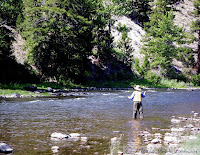
Classic trico water, bright day
Photo by Jack Mauer
3 & 4) Persistence and patience: These go hand in hand. It usually takes more than several good drifts to finally get a trout to eat your fly. This does require the utmost in persistence and the patience to wait between casts to let a stubborn trout begin to feed again and cannot be understated. Big selective trout can be extremely rhythmic in their feeding mode, so it does make sense that the timing of your cast is almost as important as the accuracy of delivery. The next dry fly fishing purist book could be entitled “the cadence of trout.” Moral of the story, it doesn’t hurt to observe for a while and not cast. Just wait it out while you observe which lends itself to a little poetry, “to cast or not to cast, that is the question.”
Finally, the hook set itself. Again the word here is patience. Many times Jack has pleaded his “God save the queen” raising of the rod to these words with clients to help slow down their hook sets in order to impale the fish. Because the patterns are tied on small gapped hooks you must be slow and methodical in the hook setting. This is a different hook setting technique than the quick hook set usually associated with nymph and bobber rigs and/or larger dry fly fishing. This technique can’t be learned over night. It requires practice.
5) Practice: Yes, he said practice. It does take practice to get good at anything difficult. To truly master this type of trout fishing it is somewhat synonymous with a great hitter in baseball. There are times when you may go into a slump. You aren’t going to get a hit every time at bat, but your percentage of success will improve with practice.
6) Pulse: The pulse of tricos is affected by weather. The best weather patterns that bring on consistent spinner falls are windless, warm partly sunny days. A stable high pressure dome sitting over the Rockies will get trout into a predictable morning feeding rhythm. A change to cool rainy weather will disrupt your spinner falls and cause a down pulse.
In conclusion, you can be doing everything right, make good presentation, hook a beautiful fish with a nice slow hook set, play him for one long run and then have him shake the hook or break off in a weed bed. This is where the joy can turn to agony. But therein lies the challenge of what trout fishing is all about. Hopefully these tips can help you catch more trout during trico time.
For more info:
Montana Fish, Wildlife and Parks – Fishing information
Wapiti Waters Fly Fishing Montana – Seasonal hatch primer for western Montana
Westfly Entomology – For the western fly fishing community
Merle’s SmugMug photo site – More river and fishing photos in their original format Incudes Big Hole, Bitterroot, Blackfoot, Clark Fork, and Missouri rivers during the months of March through November with captions
Merle's SmugMug trico photos - better resolution
If you like these articles, be the first to see them, subscribe by email (see above), by RSS, Twitter, or Facebook.
Joys and agonies of trico fishing

Trout rise form during a trico hatch
Photo by Merle Ann Loman
Related Articles
Within the fishing season there are times that one really anticipates. For many in western Montana, it is the Skwalla or salmon fly hatches early in the year. These two stonefly hatches are famous for bringing up big fish and they both come at times when you are anxious to fish -- spring before high water and right at receding high water. But another hatch later in the year will get trout feeding on top on a consistent daily basis.
The trico mayfly hatch produces spinner falls where trout jam for 2-3 hours in the morning. And, because the trico hatch lasts so many weeks, mid-August through September, one has to devise a strategy to deal with this important time. No other mayfly species is so intense.
The reasons so many surface feeding trout can be found gulping tricos have to do with the slight decrease in the water temperatures of a late summer morning and the hundreds of mayflies on the water. It is a signal to the trout that fall is coming and winter is just around the corner. “We need to stock up,” they are saying. The joy is seeing all these targets. But, despite the sheer number of tricos dancing in the air, loads of spinner falls on the water, and the active pods of sipping trout, the trout can be very difficult to catch during this hatch. The water is flat, the sun bright, and trout see so many naturals. How do you get them to take your imitation? This can be agonizing.
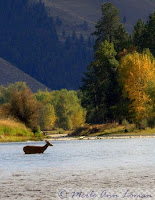
Buck crossing the river
Photo by Merle Ann Loman
Typically, western Montana’s trout fly fishing and guiding season lasts from mid-March through mid-October making trico season a very significant part. Jack Mauer of Wapiti Waters shares a few tidbits of information and wisdom that he has gained over 25 years of guiding fly fishermen and hopefully it will improve your catch rate. No doubt about it, targeting trout that are coming to the surface and feeding on these tiny aquatic insects requires a little different skill set. The best spinner falls are on partly sunny days. When the light reflects off the water and through the tippet, it will shine like a diamond necklace and alert the fish to you and your dry fly.

Classic trico water on in western Montana
Photo by Merle Ann Loman
You can be doing everything right, make good presentation, hook a beautiful fish with a nice slow hook set, play him for one long run and then have him shake the hook or break off in a weed bed. This is where the joy can turn to agony. But therein lies the challenge of what trout fishing is all about.
This is some of the toughest, most technical angling that one encounters during the season, but it also is some of the most gratifying. A morning of trico fishing is something Jack really looks forward to every year because of the challenges and rewards of catching trout during this time. To reap the rewards yourself read the second article discussing the six “P”s to better success in trico fishing. The six “P”s are patterns, precision of presentation, patience, persistence, practice, and pulse. Here is a link to Jack's Six "P"s of trico fishing.For more info:
Montana Fish, Wildlife and Parks – Fishing information
Wapiti Waters Fly Fishing Montana – Seasonal hatch primer for western Montana
Westfly Entomology – For the western fly fishing community
Merle’s SmugMug photo site – More river and fishing photos in their original format
Incudes Big Hole, Bitterroot, Blackfoot, Clark Fork, and Missouri rivers during the months of March through November with captions
Trico slideshow photos in bigger resolution on Merle's SmugMug site
If you like these articles, be the first to see them, subscribe by email (see above), by RSS, Twitter, or Facebook.
Tuesday, February 16, 2010
BEYOND HABITAT: Saving trout from the Bighorn to the Flathead in Montana

The Feb 18 BRTU meeting will feature Montana TU Executive Director Bruce Farling. Bruce will be giving a slide presentaion on the subject of:
BEYOND HABITAT: Saving trout from the Bighorn to the Flathead in Montana.
The meeting begins at 7:00 PM at the Hamilton Elks Lodge, 203 State Street, Hamilton and is open to the public.
Contact BRTU President Bill Bean for additional information call Bitterroot Trout Unlimited President, Bill Bean at (406) 363-6158, or email Bill at fishaus@blackfoot.net
Please feel free to post or forward to anyone you think might be interested.
Elks Lodge
203 State StreetHamilton, MT 59840-2522
(406) 363-3031
Tuesday, February 9, 2010
Wapiti Waters 2010 fishing forecast for western Montana
Wapiti Waters' 2010 fishing season forecast based on over 30 years experience in western Montana's trout fisheries.

Jamie and his Dad.
Jamie caught this trout in
July on the Bitterroot.
Wapiti Waters photo
Jack Mauer, Wapiti Waters outfitter and guideJamie caught this trout in
July on the Bitterroot.
Wapiti Waters photo
Related Articles
- When is the best time to fish western Montana
- Fishing for northern pike on the Bitterroot
- Fly fishing the Blackfoot River in a rain storm
- Merle's articles on Examiner.com
I have just read they will be shipping snow by truck to the site of the 2010 Olympic Games – Cyprus Mountain. Mother Nature has not cooperated but they have had time to prepare for the lack of snow. Likewise, here in the fishing business where a trout fishery depends a lot on good, cold stream flows, we have time to prepare or plan for what looks to be a lean water year.
I hate drought, everybody and everything suffers during times of water stress. Unfortunately conditions are looking more and more like drought as snowpack in the Bitterroot is around 54% of normal at the time of this writing. We have had three months of below average snow precipitation and we have less than two months of winter to go. So the prognosis is not good. What this actually means for the fishing, however, is not all gloom and doom.
Here are my predictions for the 2010 season.

Insect hatch on the Bitterroot in the spring.
Photo by Merle Ann Loman
March and April – Early Spring fishing
Expect fishable water through-out this time. Because our low elevation snow is meager, we should have better than average fishing with more fishable days. It is the melting low elevation snow that causes the rivers to pulse up too quickly with warm weather and/or rain. So I predict excellent early spring fishing in western Montana and that means Skwala and nemoura stones as well as Ameletus and Rithrogenia mayflies.
May and June – Usual period of high-water conditions
Again, I expect better than average fishing for these two months. Many hatches such as the salmonfly; pteronarcella, larger stoneflies; March Brown; and Hydropsyche caddis will come off in good numbers during this time and have the trout looking up on a more consistent basis. Pulsing high waters in the average snowpack year don’t give the trout a chance to key on these hatches before water levels may become too big. This year under the possible lower than average flows, it is likely that trout will get a chance to really key in on them. As a result, these conditions may bring some remarkable fishing.
No matter how big or small the snowpack there will be a time of peak run-off for a 2-3 week period. When this happens, most area rivers will probably be unfishable because of high, turbid water. Here is where flexibility becomes important. Some rivers will likely be fishable and changing the location/river will allow you to take advantage of good conditions. Wapiti Waters has the knowledge and permits that can put you on the right water.

David with a Bitterroot brown trout
Wapiti Waters photo
July and August – Summer fishing
Early July is usually a time of some of the most consistent fishing. I expect that to be the case given the number and variety of aquatic insects that emerge during this time. However, by mid-July the prognosis is not good. Using a preferred strategy for low, warm water conditions in mid-summer, we will need to fish from early morning to early afternoon. Fishing early is in favor the trout and yourself – beating the heat. It is quite possible that rivers like the Blackfoot and the Big Hole will have some angling restrictions during this time.
September and October – Fall Fishing
It is a little too early to predict eight months in advance. Our fall fishing is usually a fly fishers dream here in western Montana. Low flows in the summer are not the single deciding factor of unfavorable fall fishing conditions. For example, last year we had a huge snowpack but we had very tough fall fishing because of unseasonably warm temperatures and bright, sunny weather.
In the mean time, I hope the weather systems in the Pacific will deliver us some welcome precipitation through-out the year.
For more info: Wapiti Waters welcomes calls and emails for up-dated conditions and angling reports.
Contact information: Toll free 800-254-5311, email wapiti@wapiti-waters.com, website www.wapiti-waters.com.
The western Montana rivers Jack fishes most are the Bitterroot, Blackfoot, Big Hole and Clark Fork rivers. See links to more articles and information below.
- Fishing and river articles and photos by Merle Ann Loman by key word:
Here is a slideshow of more western Montana photos. To see the album on line with descriptions click Merle's western Montana fishing photo album.
Subscribe to:
Posts (Atom)