Photo documentary of camping and fly fishing the Blackfoot River in early August 2013.

- Here is the post on Facebook.
- Here is a slideshow with all the photos.


 |
| Brown trout caught by Jim |
 |
| Dr. Fauci with a trout from the Blackfoot River |

About the Bitter Root Water Forum – The BRWF is a non-profit community driven watershed group established to ensure clean, abundant surface and ground water in the Bitterroot watershed. For more information visit our web site at www.brwaterforum.org or contact the Water Forum at (406) 375-2272 or email brwaterforum@bitterroot.net.

I have just read they will be shipping snow by truck to the site of the 2010 Olympic Games – Cyprus Mountain. Mother Nature has not cooperated but they have had time to prepare for the lack of snow. Likewise, here in the fishing business where a trout fishery depends a lot on good, cold stream flows, we have time to prepare or plan for what looks to be a lean water year.
I hate drought, everybody and everything suffers during times of water stress. Unfortunately conditions are looking more and more like drought as snowpack in the Bitterroot is around 54% of normal at the time of this writing. We have had three months of below average snow precipitation and we have less than two months of winter to go. So the prognosis is not good. What this actually means for the fishing, however, is not all gloom and doom.
Here are my predictions for the 2010 season.

Expect fishable water through-out this time. Because our low elevation snow is meager, we should have better than average fishing with more fishable days. It is the melting low elevation snow that causes the rivers to pulse up too quickly with warm weather and/or rain. So I predict excellent early spring fishing in western Montana and that means Skwala and nemoura stones as well as Ameletus and Rithrogenia mayflies.
Again, I expect better than average fishing for these two months. Many hatches such as the salmonfly; pteronarcella, larger stoneflies; March Brown; and Hydropsyche caddis will come off in good numbers during this time and have the trout looking up on a more consistent basis. Pulsing high waters in the average snowpack year don’t give the trout a chance to key on these hatches before water levels may become too big. This year under the possible lower than average flows, it is likely that trout will get a chance to really key in on them. As a result, these conditions may bring some remarkable fishing.
No matter how big or small the snowpack there will be a time of peak run-off for a 2-3 week period. When this happens, most area rivers will probably be unfishable because of high, turbid water. Here is where flexibility becomes important. Some rivers will likely be fishable and changing the location/river will allow you to take advantage of good conditions. Wapiti Waters has the knowledge and permits that can put you on the right water.

Early July is usually a time of some of the most consistent fishing. I expect that to be the case given the number and variety of aquatic insects that emerge during this time. However, by mid-July the prognosis is not good. Using a preferred strategy for low, warm water conditions in mid-summer, we will need to fish from early morning to early afternoon. Fishing early is in favor the trout and yourself – beating the heat. It is quite possible that rivers like the Blackfoot and the Big Hole will have some angling restrictions during this time.
It is a little too early to predict eight months in advance. Our fall fishing is usually a fly fishers dream here in western Montana. Low flows in the summer are not the single deciding factor of unfavorable fall fishing conditions. For example, last year we had a huge snowpack but we had very tough fall fishing because of unseasonably warm temperatures and bright, sunny weather.
In the mean time, I hope the weather systems in the Pacific will deliver us some welcome precipitation through-out the year.
Contact information: Toll free 800-254-5311, email wapiti@wapiti-waters.com, website www.wapiti-waters.com.
Here is a slideshow of more western Montana photos. To see the album on line with descriptions click Merle's western Montana fishing photo album.

As we reflect on this past year, we appreciate the gain from our toils and rejoice in the memories of families and angling friends.
Another season has come and gone for Wapiti Waters. Hopefully this winter, we will be partaking in our usual cold month recreational endeavors. Unfortunately the snow hasn’t hit this part of Montana yet. After a reasonably successful hunting season, Merle and I are still hiking around the hills for exercise and “light therapy” rather than skiing. Our immediate focus is keeping the house warm, and sharing our reflections, thanks and hopes with you in this letter. Read on for a recap of our most successful guide season ever.
The 2009 guide season kicked off in mid-March with mild weather, good dry fly fishing and some happy anglers. By the end of March we had icy guides in our rods as an arctic blast descended. Unbelievable as it may seem the Skwalla dry fly fishing was pretty good despite temperatures hovering near 32 degrees. The native cutthroats are incredibly hardy fish. Grilled “brats” and hot soup was the mainstay for lunch.
The rest of spring was fair fishing with flows a little too high at times. 2009 had a huge snow pack and the threat of flooding was imminent. After one big surge in late May, an orderly run off ensued; this prevented a natural disaster. By June 9th we were fishing the Big Hole and Bitterroot forks. From then on Wapiti Waters was busy throughout the summer and into fall. With Merle on bookkeeping, lunches, website and emails, I could focus on my outfitting and guiding. Without the weekly and late Tuesday nights at the Top Hat, I was still able to play parties and weddings with the band and enjoy my music through the guide season.
Highlights from 2009:
Clark Fork is coming back quickly from the Milltown project. Insect hatches that have been suppressed in previous years are showing up again which has stimulated nice angling in certain sections.
The Big Hole had exceptional flows and terrific fishing throughout the season. What a joy to be on this river in August floating and wading in some of the finest trout water in North America.
A hot, sunny September to remember made for some very technical angling. After a predictably good morning trico spinner fall we would take a little time to do some invasive species management. We searched and found northern pike lairs and were modestly successful at pulling some out. What a thrill to see them pursue the fly, strike it and playing that size of a fish. It is a nice change of pace and 180 degrees from trico fishing. For the Pike, we used a 9 weight fly rod and a 2 “aught” air resistant streamer instead of the 4 and 5 weights with a size 20 dry. Now that is variety.

Another arctic freeze-out in early October disrupted an unusually good month of fishing. Fall colors were a gloomy grey green. It was still beautiful to be out but we felt we got cheated without the vibrant yellow and oranges that our stream corridors normally exhibit. We know we can’t always have it the way we want it and we especially appreciated the nice BWO and mahogany dun hatches.
First, we want to thank those who fished with Wapiti Waters in 2009 and wish you all Happy Holiday and a prosperous New Year in 2010 and second (and as important) all the great guides who worked with us.

Naturally we will begin with spring. Fish are coming out of a dormant period by mid-March with milder weather and water temperatures. Spring with its predictably unpredictable weather does have its special moments. The Bitterroot, Big Hole, Blackfoot, Clark Fork and Missouri will ‘come in’ at different times from mid-March through May. Naturally extreme weather (too cold OR too warm) can ruin the angling, yet spring has some wonderful hatches. You will see stoneflies; Skwalla and Nemoura, mayflies; March Brown and Blue-winged Olives (BWO), and lastly caddis that can trigger some unbelievable opportunities. Fishing “underneath” with either nymphs or streamers can also be very productive. One must be somewhat of a gambler to fish in the spring. The rewards can be gratifying for the lucky angler who strikes it rich.
Starting in mid-May, rivers will begin to surge as warm, mild weather begins melting the snowpack. A typical run-off will last over a period of about 5 weeks or so depending on the amount of snowpack. However, the craziest streamer and nymph fishing ever has happened between run-off pulses during this time period.
Early summer is probably the most popular time to fish western Montana, right after main run-off events are over, typically around mid-June when river flows decrease and gain clarity. Hatches of salmonflies, golden stones and green drake mayflies make their annual appearance. This can be an especially productive time for the inexperienced angler as trout are hungry, relatively uneducated, and the water is fast and forgiving. One can get away with a little more drag on the surface fly and use heavier tippets and larger patterns. For many of my fisherman, the last 10 days of June and first 10 days of July are the best time to fish. It is difficult to argue as the good hatches, healthy river flows and early summer weather are hard to beat. It is also the time of year that most people are recreating on our area rivers and is to be expected. Wapiti Waters does its best to avoid getting into a crowded fishing scene and having to “compete.”
Eventually the fishing settles down into a mid-summer rhythm, always dependent on weather. The explosive hatches of larger insect species are over and too many days of hot weather really slows down the trout. Mid-summer slides into the so-called ‘dog days’ with morning PMDs spinner falls and the Isoperlid Stoneflies like yellow sallies are about the only aquatic insects out there. However there have been memorable moments in certain river reaches with terrestrial patterns like beetles, ants, grasshoppers and moths. This time period (mid-July through mid-August) is an excellent time to be on the water particularly for the early riser as the morning fishing can be very good. Many Wapiti waters customers prefer this time as area rivers have noticeably less fishing pressure.

At the end of August, longer nights and cooler weather turn on the bugs and the trout. The tiny black curse (trico mayfly) begins to make its appearance and cloud up the morning sky with its mating dance. Once on the water these little bugs give anglers the most challenging as well as rewarding fishing opportunities of the year. The patterns are small; one’s casting must be accurate and soft and hooks sets slow. In other words good technique is usually required. But because the opportunities for finding rising trout are numerous, you can get a lot of practice refining your technique. After a morning of trico fishing, an afternoon of hopper and/or fall drakes is likely to follow. For many dry fly purist, this time period is best as fish can be found rising throughout the day.
Later in September, the above mentioned hatches are followed by BW and mahogany dun mayflies, October caddis and midge swarms that take us right into late-fall. During our fall fishing one can expect to find pretty consistent hatches, sipping trout and fall colors that make this my personal favorite time to fish. This is a quality time particularly for the late riser as afternoon fishing is the norm.
We hope this answers the question about the best time to fish. I don’t like to promise good fishing just because you’re booked, say the first week of July or early September. So much of the fishing depends upon factors we have no control over such as weather and stream flows …but when the fishing is just tough we will always go back to the Robert Traver quote, “I fish because I love to; Because I love the environs where trout are found…” See the entire quote below and Thank you for reading this article.
No matter what time of year, Wapiti Waters always works hard to find your best fishing.
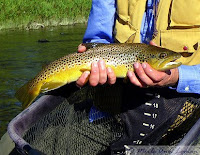
Fall brings cooler temperatures that cue brilliant foliage, migrating geese and spawning brown trout.
Brown Trout (Salmo trutta) is an exotic species in Montana. It was introduced to North America and Montana in the late 1800’s. Brown trout belong to a different genus than our native trout species. Widely stocked early in this century, they are currently doing well as a self-sustaining population.
The brown trout are golden brown with spots, lots of spots. They have black spots that may be irregular, and often red and orange spots. A distinct characteristic is spots with halos on the gill covers. Their tails are short and square. They commonly grow to 12 to 20 inches, but Montana’s state record is 29 pounds.
Brown trout feed largely on underwater aquatic insects. And, as a predaceous fish, more so than rainbow or cutthroat, the larger browns often feed at night on other fish, crayfish and other invertebrates. Brown trout have a few advantages over native Montana trout species. Brown trout are better adapted to disturbed habitats, and can live in areas that experience unnatural changes in water level, temperature, and water quality.

Brown trout also lay their eggs in the fall, getting a jump on the native species which spawn in the spring making them subject to irrigation seasons water fluctuations among other things. Spawning occurs for brown trout when water temperatures drop to about 40 degrees F. and lasts usually from October through December in Montana. Female brown trout make redds in gravel or small pebbles in shallow water, usually less than a foot deep. Females deposit the eggs, males fertilize the eggs and they are covered with very small gravel or silt. In the spring, about 50 days later and at 50 degrees F, the surviving eggs hatch.
Some brown trout spawn on their resident rivers, but to find the right (very specific) conditions most migrate, sometimes traveling great distances upriver or into tributaries. During this critical time for brown trout, if you are aware of spawning beds where you are fishing, it is preferable not to disturb them.
Here are some things to think about when fishing during the spawning period:
Brown trout are usually in the larger, slower and lower gradient streams often where there are logs and other structure available to hide under. They also do well in reservoirs.
Brown trout are a popular game fish and a challenge to catch because they are selective and wary. When an angler catches them, it is exciting as they can be large and put up a good fight, running with the line.
 John Corrigan took a working/vacation trip to the northwest US in late August. He attended a conference in Portland, Oregon, and after taking care of business, rented a car and headed east. When he reached western Montana he met and fished with Wapiti Waters on the Bitterroot and Blackfoot Rivers.

See some of his writing at the Concord Monitor in NH
Below are snippets of his three most recent articles. Click the links to read more.Finding inspiration in Montana
Sun Sep 6, 2009
A rental car motored through it. William Least Heat-Moon's book, Blue Highways, chronicled his travels along the back roads once marked on maps with blue lines. more...
Making connections out west
Sun Aug 30, 2009
Anticipation leads to the memories. Fishing comes in between. As you read this, my second western fishing trip of the season has become a memory. I was scheduled to arrive back home from Montana la... more...
 Nick Stipech is a talented Missoula area guide and Jack loves working with him. We all had an open day so we fished the lower Blackfoot River on Friday. Fishing with guides is the best way to really know their strengths and match them up well with clients.


 Last week we had temperatures in the upper 90 degree range. For us, that is very hot. The water levels were dropping dramatically and the water temperatures were rising on all rivers but the Big Hole and the Blackfoot water temperatures were in the upper 60 and lower 70 degree range. Low water flows and high temperatures stress trout, making them especially vulnerable to disease and predators.
In conditions like these, Wapiti Waters’ goal is to get out early and get off before the water temperatures peak in the late afternoon. We also choose reaches that have cooler/higher water. It is better fishing, easier on the trout and more pleasant for the anglers. Our guides are knowledgeable and skilled at using the tips listed below.
Last night we had a good rain. The short range forecast is for a bit cooler temperatures and we are already seeing water temperatures drop. But, we are heading into August and it will probably heat up again. It is worthwhile to understand how to fish responsibly during hot weather.
Drought Tips by Montana, Fish, Wildlife and Parks
Fish will feel the stress caused by low flows, higher water temperatures and competition for space and food. Low water conditions in spring and fall can cause spawning failures and increased predation on young fish. Also, fish will "group up" to take advantage of pools where the water is deeper and cooler -- making them more vulnerable to anglers and predators. If conditions worsen, fish are lost to stress from the higher water temperature, lower oxygen levels, and reduced resistance to disease. These threats can impact adult trout numbers in future years.
To help preserve a threatened fishery anglers can:
Anglers who practice catch-and-release fishing can minimize the stress they place on fish:
On streams experiencing extreme drought conditions and high water temperatures anglers may want to avoid catch and release fishing as it is difficult for trout to recover under these conditions.
Bull Trout, Arctic Grayling, West Slope Cutthroat Trout are species of concern in Montana.
More information on...
Arctic Grayling on the Big Hole and management during hot/dry conditions:Bull Trout ID site on MT FWP
Under FWP’s drought plan, angling restrictions are called for on streams that provide habitat for bull trout when stream flows reach 1-in- 20-year lows and maximum daily water temperatures equal or exceed 60 degrees for three consecutive days. For all other trout, the water temperature to trigger angling closures is 73 degrees for three consecutive days.

The Big Hole River Watershed Committee identifies when low river flows should trigger angling closures.These trigger points were met in early August of 2006, placing the river’s grayling at risk. The upper and middle reaches of the Big Hole totaling 47 miles were closed due to low water flows and high water temperatures.
The upper reach of the river was not opened until it exceeded 40 cfs for at least seven consecutive days with water temperatures that did not exceed 70 degrees for more than eight hours a day for three consecutive days. The middle reach reopened when the river exceeded 80 cfs for at least seven consecutive days with the same water temperature guidelines.To read more, click this link for Big Hole River Drought Management Plan
Note: 21 °C = 70 °F, 16 °C = 61 °F
Click here for Wapiti Waters Stream Flow Links

 Contact: Vivaca Crowser, Information Officer


