Blog format on our website

Jack C. Mauer has more than a thirty year investment in fishing, floating and wading the waters of western Montana. He is intimately acquainted with the surrounding fisheries and their corresponding ecologies. It is his passion and enthusiasm for the art of fly fishing, a respect and knowledge of trout habitat, and the ability to expertly instruct the technical aspects of fly fishing that clients appreciate as they return to western Montana and Wapiti Waters. Contact Jack at 800-254-5311.

Visit our WordPress format for Wapiti Waters Blog.


Sunday, October 25, 2009

Argentina - fly fishing and more in the Patagonia region

Rio Chimehuin
Jack Mauer on Rio Chimehuin (Photo by Merle Ann Loman)

Fly fishing in Montana might be similar to fly fishing in Argentina, but Argentina’s open spaces are even vaster. Jack Mauer first visited the Patagonia region of Argentina in February and March of 2006. He knew that there would be great fly fishing and made the most of it by floating, fly fishing and camping on many different rivers. In 2008, he and his partner, Merle, visited in February and March again. On this trip they spent time in Buenos Aires, San Carlos de Bariloche and San Martín de los Andes. They also fished three rivers, the Chimehuin, Malleo and Collón Curá in the Neuquén District of Argentina. On Jack’s first trip, he fished all these and the Limay, Aluminé and Caleufu rivers.


A favorite city to enter the country is the capitol, Buenos Aires. Take the time to explore the city. It is a vibrant and friendly city with outstanding restaurants, shops, museums and architecture. Taxis, buses and walking are great ways to get from district to district.

Church in Buenos Aires
Church in Buenos Aires (Photo by Merle Ann Loman)


The domestic airport in Buenos Aires is the Jorge Newbery Airport. From there, they flew an Argentinean airline, LAN, to a beautiful town at the base of the Andes called San Carlos de Bariloche. The busy city is on the shores of Lake Nahuel Huapi, which combined with mountains and forests makes a picture book site and offers much for an outdoor enthusiast to do in both summer and winter. Cerro Catedral, one of Argentinas largest ski areas, is just minutes from town. To the north, by way of a beautiful drive through forests and by lakes, are San Martín and Junín de los Andes.

San Martín is on the shores of Lake Lacar. It has a busy bus station. Public buses are a popular way to travel in Argentina. The downtown area and central park are just a few blocks from the lake. The shops are colorful and bustling with activity and goods.

Junín is a bit smaller and is on the banks of the river Chimehuin. It has motels, restaurants, grocery stores and shops surrounding its central park.

Rio Collon Cura
Rio Collón Curá (Photo by Merle Ann Loman)


Based out of San Martín, Jack and Merle fished the Chimehuin and Collón Curá, floating and camping for three days. They also spent a day wade fishing the Malleo. For lots of photos of the above mentioned towns and rivers see Merle’s SmugMug photo site, Argentina photos.

Traveling in Argentina is easy and safe as long as you use common sense and keep your valuable belongings with you or safely locked in your lodging. It is useful to visit travel blogs, such as Trip Advisor to see what other people have experienced. The airlines, buses, taxis and rental car companies give you many options for getting around. The infrastructure is modern and well maintained. People in Argentina are very friendly and helpful, many of them speaking English fairly well.

If you want to fish, as in Montana, you need a fishing license. The cost was around $50 at fly shops. Jack recommends using a professional fly fishing guide. Be sure to visit a reputable fly shop for your license and guide. There are rogue guides that are not licensed properly and you do not want to get in trouble with the law by using an unlicensed guide off the street. There are many shops and lodges that hire qualified guides that have a picture ID with proof of license and insurance. The cost of a day fishing float compares to Montana starting at about $400 and going up from there. The best months to fish are November through March.

For more info:

If you like this article, be the first to see the more, subscribe by email at Merle's Outdoor Recreation site on Examiner.com. You can also subscribe by RSS, Twitter, or Facebook. More Argentina and fly fishing articles coming soon!


Friday, October 23, 2009

When is the best time to fish western Montana?

Spring fishing on the upper Bitterroot
This is the question I am most often asked. In my attempt to answer it, I will take a brief look at our seasons chronologically and try to highlight a few of the more memorable fishing moments in an ‘average’ year.

Naturally we will begin with spring. Fish are coming out of a dormant period by mid-March with milder weather and water temperatures. Spring with its predictably unpredictable weather does have its special moments. The Bitterroot, Big Hole, Blackfoot, Clark Fork and Missouri will ‘come in’ at different times from mid-March through May. Naturally extreme weather (too cold OR too warm) can ruin the angling, yet spring has some wonderful hatches. You will see stoneflies; Skwalla and Nemoura, mayflies; March Brown and Blue-winged Olives (BWO), and lastly caddis that can trigger some unbelievable opportunities. Fishing “underneath” with either nymphs or streamers can also be very productive. One must be somewhat of a gambler to fish in the spring. The rewards can be gratifying for the lucky angler who strikes it rich.

Starting in mid-May, rivers will begin to surge as warm, mild weather begins melting the snowpack. A typical run-off will last over a period of about 5 weeks or so depending on the amount of snowpack. However, the craziest streamer and nymph fishing ever has happened between run-off pulses during this time period.

Early summer is probably the most popular time to fish western Montana, right after main run-off events are over, typically around mid-June when river flows decrease and gain clarity. Hatches of salmonflies, golden stones and green drake mayflies make their annual appearance. This can be an especially productive time for the inexperienced angler as trout are hungry, relatively uneducated, and the water is fast and forgiving. One can get away with a little more drag on the surface fly and use heavier tippets and larger patterns. For many of my fisherman, the last 10 days of June and first 10 days of July are the best time to fish. It is difficult to argue as the good hatches, healthy river flows and early summer weather are hard to beat. It is also the time of year that most people are recreating on our area rivers and is to be expected. Wapiti Waters does its best to avoid getting into a crowded fishing scene and having to “compete.”


Eventually the fishing settles down into a mid-summer rhythm, always dependent on weather. The explosive hatches of larger insect species are over and too many days of hot weather really slows down the trout. Mid-summer slides into the so-called ‘dog days’ with morning PMDs spinner falls and the Isoperlid Stoneflies like yellow sallies are about the only aquatic insects out there. However there have been memorable moments in certain river reaches with terrestrial patterns like beetles, ants, grasshoppers and moths. This time period (mid-July through mid-August) is an excellent time to be on the water particularly for the early riser as the morning fishing can be very good. Many Wapiti waters customers prefer this time as area rivers have noticeably less fishing pressure.

Bitterroot in the summer with father and son

At the end of August, longer nights and cooler weather turn on the bugs and the trout. The tiny black curse (trico mayfly) begins to make its appearance and cloud up the morning sky with its mating dance. Once on the water these little bugs give anglers the most challenging as well as rewarding fishing opportunities of the year. The patterns are small; one’s casting must be accurate and soft and hooks sets slow. In other words good technique is usually required. But because the opportunities for finding rising trout are numerous, you can get a lot of practice refining your technique. After a morning of trico fishing, an afternoon of hopper and/or fall drakes is likely to follow. For many dry fly purist, this time period is best as fish can be found rising throughout the day.

Later in September, the above mentioned hatches are followed by BW and mahogany dun mayflies, October caddis and midge swarms that take us right into late-fall. During our fall fishing one can expect to find pretty consistent hatches, sipping trout and fall colors that make this my personal favorite time to fish. This is a quality time particularly for the late riser as afternoon fishing is the norm.

We hope this answers the question about the best time to fish. I don’t like to promise good fishing just because you’re booked, say the first week of July or early September. So much of the fishing depends upon factors we have no control over such as weather and stream flows …but when the fishing is just tough we will always go back to the Robert Traver quote, “I fish because I love to; Because I love the environs where trout are found…” See the entire quote below and Thank you for reading this article.Lower Bitterroot in the fall

No matter what time of year, Wapiti Waters always works hard to find your best fishing.


THE TESTAMENT OF A FISHERMAN
Robert Traver 1964, (Judge John Voelker 1903-93)

I fish because I love to;
Because I love the environs where trout are found, which are invariably beautiful, and hate the environs where crowds of people are found, which are invariably ugly;
Because of all the television commercials, cocktail parties, and assorted social posturing I thus escape;
Because, in a world where most men seem to spend their lives doing things they hate, my fishing is at once an endless source of delight and an act of small rebellion;
Because trout do not lie or cheat and cannot be bought or bribed or impressed by power, but respond only to quietude and humility and endless patience;
Because I suspect that men are going along this way for the last time, and I for one don’t want to waste the trip; because mercifully there are no telephones on trout waters;
Because only in the woods can I find solitude without loneliness;
Because bourbon out of an old tin cup always tastes better out there;
Because maybe one day I will catch a mermaid;
And, finally, not because I regard fishing as being so terribly important but because I suspect that so many of the other concerns of men are equally unimportant - and not nearly so much fun.


See photos from early spring through late fall in the slideshow below.


View Album Click view album to see in new larger window, choose "slideshow" for full screen mode.

Wednesday, October 21, 2009

Fly Fishing the Bitterroot River in October with Jack

Bitterroot Rainbow

Rainbow on the Bitterroot River
(Photo by Merle Ann Loman)

Fly fishing the Bitterroot River in the fall is fantastic. The weather changes dramatically during the day giving stellar light shows and the fall hatches mean you will probably see fish noses and fins in select places. As the trout work the hatch, It is definitely a challenge to have targets to throw to. The fun part is trying to pick out which rise form is the biggest trout. By this time of year the trout have seen just about everything but a good presentation. In other words they are very educated but still feeding consistently. The flat smooth water where you find them feeding makes it even more difficult to execute a convincing presentation and drift. Proper selection of dry-flies and tippet are essential.

Give yourself plenty of time to concentrate on certain areas. On the Bitterroot River, there are many pods of feeding fish giving the amateur angler lots of chances to work on technique. If you put the fish down with bad casts, just row back up and wait. Chances are, they will begin feeding in a similar place again. If you don't want to row up-river, keep going to the next pod. You can see them feeding as you float down the river. Very cool.


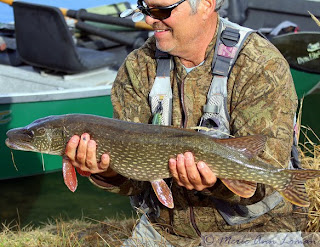
Jack with a northern pike
Jack Mauer with a Northern Pike (Photo by Merle Ann Loman)

Want a change of pace? Bring along a 9 weight rod and a box of colorful streamers. As you fish for trout and you come upon a backwater of slow water with significant drop-off next to it, you might consider changing your arsenal to a heavier rod and a very large bright streamer. You have just come into northern pike habitat and they are a HEAVY fish. If you throw the streamer at the drop-off, let it sink and then retrieve it in frequent jerking motions, you will likely tick-off a pike. When a pike hits the fly, you have a fight on your hands. Pike are non-native and predatory so catching them and getting them out of the river is a good thing. The pike in the photo to the right had a whole fish in its stomach. See the slideshow for pictures of the fish. It isn't pretty.

This pike was about 33 inches long and a tremendous fighter. As Jack caught it, another boat approached from behind. You could hear them cheering Jack on as he worked at bringing the fish into the boat. He thought about getting to shore and landing it there, but it was netted from the boat, barely fitting the net.

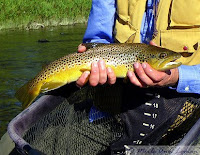
Cutthroat Trout from the Bitterroot River
Cutthroat trout (Photo by Merle Ann Loman)


This particular day was about 50 degrees with a slight breeze and overcast. The sun and clouds created unbelievable light shows. Even though this autumn hasn't produced as many colors and hues as usual, the rainbows and even the gray cast of the aspen have been beautiful. Besides amazing scenery, birds provided entertainment. While looking down the river at pods of fish feeding, beyond and on the curve was an Osprey looking for its dinner. It flew in a tighter circle, dove straight down and made a huge splash. As it came out of the water, there was a sparkle as the sun hit the fish in its talons - probably a whitefish. A few minutes later an eagle soared down the river, passed over the boat and continued downstream. Near the take-out, a Belted Kingfisher played the bank. They are a funny looking bird with a shaggy crest or topknot.

For more info:

Bitterroot River – Wapiti Waters Fly Fishing Montana description
Montana Fish, Wildlife and Parks – Field guide for Northern Pike
Montana Fish, Wildlife and Parks – Field guide for Belted Kingfisher

Montana Fish, Wildlife and Parks – Field guide for Bald Eagle
Montana Fish, Wildlife and Parks – Field guide for Osprey
Merle’s SmugMug photo site – More Bitterroot River photos in their original format

If you like these articles, be the first to see them, subscribe by email (see above), by RSS, Twitter, or Facebook.


Monday, October 19, 2009

Fly Fishing in Oct - Peter and Chris on the Bitterroot and Clark Fork

Chris on the Bitterroot Peter and Chris fished two day with Jack on two different rivers. They really lucked out with the weather. It has been cold, but this Saturday and Sunday, the weather warmed and we and the fish were grateful.Peter's trout

The first photo is Chris on the Bitterroot River.

To the right is a close-up of one of Peter's Trout.


The last photo is Peter on the Clark Fork River.


Peter on the Clark Fork Hopefully, Peter and Chris will send us some of the photos they took, maybe even a short video. Thanks for fishing with us!

Saturday, October 17, 2009

A nice fall day fly fishing the Bitterroot with Richard and Jack

Richard on the Bitterroot
After a cold spell, there was this very nice day in October. Richard and Jack fished the middle to lower Bitterroot and the fish were very cooperative. The water is very clear and flat. This means the fishing was technical because your fly presentation and drift must be convincing, no drag in the line.

See the slide show to see some of the fish they caught.

Tuesday, October 6, 2009

Fall means brilliant colors and brown trout are spawning.

It is fall in Montana and great fishing, but watch out for redds. Brown trout are spawning.
Brown trout from the Bitterroot in the spring

Fall brings cooler temperatures that cue brilliant foliage, migrating geese and spawning brown trout.

Brown Trout (Salmo trutta) is an exotic species in Montana. It was introduced to North America and Montana in the late 1800’s. Brown trout belong to a different genus than our native trout species. Widely stocked early in this century, they are currently doing well as a self-sustaining population.


The brown trout are golden brown with spots, lots of spots. They have black spots that may be irregular, and often red and orange spots. A distinct characteristic is spots with halos on the gill covers. Their tails are short and square. They commonly grow to 12 to 20 inches, but Montana’s state record is 29 pounds.

Brown trout feed largely on underwater aquatic insects.
And, as a predaceous fish, more so than rainbow or cutthroat, the larger browns often feed at night on other fish, crayfish and other invertebrates. Brown trout have a few advantages over native Montana trout species. Brown trout are better adapted to disturbed habitats, and can live in areas that experience unnatural changes in water level, temperature, and water quality.

Jeff's Brown trout on the Bitterroot River
Brown trout caught by Jeff


Brown trout also lay their eggs in the fall, getting a jump on the native species which spawn in the spring making them subject to irrigation seasons water fluctuations among other things. Spawning occurs for brown trout when water temperatures drop to about 40 degrees F. and lasts usually from October through December in Montana. Female brown trout make redds in gravel or small pebbles in shallow water, usually less than a foot deep. Females deposit the eggs, males fertilize the eggs and they are covered with very small gravel or silt. In the spring, about 50 days later and at 50 degrees F, the surviving eggs hatch.

Some brown trout spawn on their resident rivers, but to find the right (very specific) conditions most migrate, sometimes traveling great distances upriver or into tributaries. During this critical time for brown trout, if you are aware of spawning beds where you are fishing, it is preferable not to disturb them.


Here are some things to think about when fishing during the spawning period:


  • Stay away from the redds, do not walk in them. In general, they will be in clean gravel and it will look like someone dug a hole in the smaller gravel.

  • Fish downstream to the probable pods of trout below the redd, not IN the redd. A clue is fish sitting on top of thecleared off gravel in pairs.

  • If you catch a spawning trout, try not to sap their strength; play them quickly, release them quickly and of course, handle them gently.

  • Last, target fewer fish. Catch a few, and then move on to another area.


Brown trout are usually in the larger, slower and lower gradient streams often where there are logs and other structure available to hide under. They also do well in reservoirs.

Brown trout are a popular game fish and a challenge to catch because they are selective and wary. When an angler catches them, it is exciting as they can be large and put up a good fight, running with the line.

For more info:
Montana Fish, Wildlife and Parks – Field guide for brown trout

Montana University System Water Center – Brown trout information

Utah on the Fly Article – The Bedroom of the Browns: Acting Responsibly During the Spawning Season, by Jim McGeever

Merle’s SmugMug photo site – Many more brown trout photos in their original format


Wednesday, September 30, 2009

Fly fishing the Bitterroot - finally rain!

Tommy with his troutTommy caught this nice fish on a rainy day on the Bitterroot. It has been a very warm and dry fall. The rain is welcomed by us and the trout.Tommy's trout

Wednesday, September 23, 2009

Fly Fishing the Bitterroot with the Andrew and Diana

Andrew on the Bitterroot River
They drove up from Ketchum, Idaho to Triple Creek Ranch near Darby (they live in the mid-west). It is difficult to find a more beautiful drive. Their next adventure was to fish the Bitterroot River. You can't beat that!

Fly fishing and hunting is what Billy Burk loves

Billy Burk's trout
Billy Burk is a friend from Colorado. He is a busy guy with family, work and of course his outdoor recreation. He has been building a "trophy room" and I asked for photos. It isn't quite "decorated" yet, more photos and mounts to hang. Nice!

When he included these photos of trout he photographed in the Arkansas River, I had to blog them.

Tuesday, September 22, 2009

Casey, a man of four rivers and at least four pike

Casy and Aaron on the Flathead River
Casey Hackathorn is an Outfitter/Guide out of Missoulian Angler in Missoula, MT. He and Jack have this bond: a fascination for pike, actually BIG pike. So far Casey is the winner but then he has been at it longer. I see a long running competition developing. Fun!


Missoulian Angler Fly Shop
Website
401 S Orange St ·
Missoula
(406) 728-7766

We highly recommend the Missoulian Angler Fly Shop and Casey Hackathorn. Professional, great selection and service and the staff is exceptional. Visit them when you are in Missoula.


All photos were sent to us by Casey Hackathorn.

Monday, September 21, 2009

Northern Pike fishing adventure on the lower Bitterroot River with Jack Mauer

Northern Pike caught in the Bitterroot River by Jack Mauer

Jack Mauer fishes for a living, but what does he do on his day off? He gets up early and goes fishing for Northern Pike. His favorite spot is a section in the lower Bitterroot (exact location is undisclosed at this writing). For this short but productive float, he has permission to put in on private land and takes out at the next public access point. I get invited along for many reasons: photography, dog handler for our 6 month old Chesapeake puppy, and last but not least, rower of the boat when we get to pike territory.

Northern Pike, or pike, or northerns, are native to Montana but only in the Saskatchewan River drainage on the east side of Glacier Park. They have been illegally introduced in many areas and are now present in every drainage west of the Divide. A highly piscivorous animal, they feed on fish and also eat other vertebrates such as frogs. Northern pike threaten native game and non game fish in the area and popular sport fish like rainbow and brown trout.

With a long skinny head they have large teeth on the side of their mouth, and rows of many small teeth inside their mouth. They don’t chew their food, they just swallow it whole. Characteristics of the pike are: light markings on a darker green body, lower half of the cheek completely scaled; five or fewer pores on each side of the underside of the jaw; and rounded tail tips.

Pike especially like lakes and reservoirs, but on the Bitterroot River they are found in the warmer, slower water. Weeds are used for camouflage while hiding and waiting for food to float or swim by. They tend to live in water which is less than 15 feet deep, near a backwater area and close to shore. A submerged log in about 7 feet of water is another prime hang out spot for Pike. Because the Bitterroot is Jack’s home river, he has located the buckets of water where the pike are and can row directly to them.

When fishing for northerns, it might be a good idea to use a steel leader (a short piece of steel line). The pike's sharp teeth will cut easily through most fishing regular fishing line. Jack uses an 85 pound test hard monofilament tippet with a very bright streamer that has 2 hooks.

The idea of the streamer is to try to imitate the features of baitfish and minnows, which are what pike naturally feed upon. Since Pike seek their prey by sight, it is important for the streamer to move, so active artificial movement or live bait movement is very important. Anchor the boat above the holding water so you can cast to the bottom end of the bucket and retrieve your line through it and past the pike. Jack fished both deep (with a streamer that sinks and swims) and more on the surface (with a streamer/fly that didn’t sink as well). In both cases, he casts out about 60 feet or more, hopefully beyond the pikes position. Then he retrieves his line with a subtle jerking motion and some pauses in between twitches. The goal is to attract the attention of the pike and make it think his streamer is injured prey. Sometimes after hooking a pike, he saw other pike chasing it to the boat looking for their own meal.

After hooking and reeling in the pike, Jack uses a huge pair of needle nosed pliers to get his streamer and hook out of that nasty looking mouth.

Unlike fishing for trout, you want a bright day to fish for pike. If the water is smooth, meaning not much wind, and the sun is at an angle instead of right above you, you can see this distinctive fish in the water. This might be obvious, but sighting a pike makes it much easier to cast to.

Small northern pike remain in shallow weedy water through much of the year. In mid-summer, forage reaches peak abundance and the fish remain active. Large northern pike move deeper as summer progresses and water temperatures warm, seeking oxygenated water of 65 degrees or cooler. Large northern pike become lethargic in warm water, eating little and sometimes losing weight. For these reasons northern pike fishing falls off in warmer weather.

Jack has more time to fish for pike, and in addition on the lower Bitterroot River there is often the opportunity for good trico fishing. It makes for a great day with a wide variety of fishing styles, i.e. fishing a No. 18-20 trico dry fly on 6X tippet versus a larger, flashy streamer with 85 test monofilament tippet and a heavier rod.

Northern Pike are exceptionally good to eat, with firm, white flesh. The bigger fish are easier to bone and except for one troublesome Y-shaped bone, the Pike is relatively easy to filet. You can serve it many ways including grilled, fried, and baked using whatever seasonings and sauces you like. Jack isn’t much of a fish eater but he has a number of friends that like to eat the pike so he gives them away. That is a win/win for the trout in the river and his friends.

This aggressive and voracious fish attacks the lures or flies and puts up a great fight making the catching a thrill. Northern pike can grow to nearly 40 pounds in Montana and provide an outstanding sport and food fish in the appropriate waters. Pike are caught not only for sport but also to help get them out of inappropriate waters. Because of their voracious fish-eating habits they can literally eliminate their food supply in only a few years, leaving a population of terminally-stunted "hammerhandles." This is why widespread illegal pike introductions in western Montana have become a fishery manager's nightmare. So, go ahead, get out there, harvest a few pike and help Montana Fish, Wildlife and Parks with removal of unwanted populations!

To see all the photos in a new window, click Jack's Trico/Pico fishing day.


Resources and links

Billings, Montana Pike Fishing Club called Pike Masters

Montana, Fish Wildlife and Parks Field Guide for Northern Pike and Northern Pike Education Page
I only found a few articles on strategies for pike fishing. Below is a link to an article from Game & Fish Magazine with useful information on pike and how to fish for them.
Northern Pike Strategies by Jim Barta from Michigan - If you are a northern pike fanatic, the author has a few weapons you should consider adding to your arsenal.

Wednesday, September 16, 2009

Fly Fishing the LOWER Bitterroot for trout and pike with Bob and Ferguson

Bob with  a lower Bitterroot River trout
Jack met Bob and Ferguson at a public access and fished the very LOWER Bitterroot for trout and pike. This is near the confluence of the Clark Fork and Bitterroot Rivers and is great habitat for both species of fish. Here are 4 different views of one of Bob's nice cutthroat trout.


Jack brought one pike home to give to a friend who likes to eat them but they didn't get any photos of pike.

I like showing the river and it's features, but also to show close up views of the trout. Here is the slideshow of the 4 photos.